From Sana’a to the red sea.. how did Iran lgnite Yemen and turn it into a platform for Its regional wars?
Since the outbreak of the war in Yemen in 2014, the country has transformed from an internal political crisis into one of the most complex arenas of regional conflict in the Middle East, with the Iranian role escalating through political, military, and media support for the Houthi group.
Over the past years, the impact of this intervention has no longer been limited to Yemen’s internal situation, but has extended to regional security and international navigation, especially after the escalation of attacks on commercial ships in the Red Sea and Bab al-Mandab, one of the world’s most important trade corridors.
While Iran confirms that its support for the Houthis comes within the framework of “supporting the forces of resistance,” Arab governments, the United States, and Western countries believe that Tehran is using Yemen as a strategic pressure card within its regional conflict, even if that comes at the expense of the stability of the Yemeni state and the future of its people.
Iranian influence in Yemen began to expand gradually since the first decade of the new millennium, but it was reinforced in an unprecedented manner after the Houthis took control of the capital, Sana’a, in September 2014 and forced the internationally recognized Yemeni government to retreat.
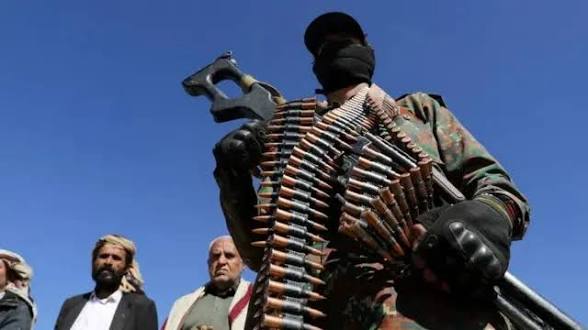
Since then, the United Nations and multiple international reports have accused Iran of providing advanced weapons and military technologies to the Houthis, including ballistic missiles, drones, explosive boats, and military communication systems.
Reports by the United Nations Panel of Experts on Yemen have shown technical similarities between some of the weapons used by the Houthis and Iranian-made military systems or systems developed with Iranian support.
As the war evolved, the Houthis became part of the regional influence network linked to Tehran, alongside other armed groups in the region. Iran views this network as a means of strengthening its strategic influence and exerting pressure on its regional rivals, especially Saudi Arabia and the Gulf Arab states.
This was clearly reflected in the attacks that targeted Saudi oil facilities and border cities during past years, using missiles and drones claimed by the Houthis.
In 2019, the attack on the “Aramco” facilities in Abqaiq and Khurais caused Saudi oil production to temporarily drop by nearly half, representing a major shock to global energy markets, despite the continued international debate regarding the party directly responsible for the operation.
However, the most dangerous phase of escalation emerged after the outbreak of the war in Gaza at the end of 2023, when the Houthis intensified their attacks on commercial ships in the Red Sea under the pretext of targeting ships linked to or supporting Israel.
According to international data and global shipping companies, these attacks caused major disruptions to global trade movement, as approximately 12% of international trade and nearly 30% of global maritime container traffic pass through the Red Sea.
The security risks prompted many major shipping companies to reroute their vessels away from the Suez Canal toward the Cape of Good Hope, increasing maritime transport costs and leading to a rise in global insurance and shipping prices.
These developments raised widespread fears of Yemen turning into a permanent platform for threatening international navigation, especially with the repeated targeting of commercial ships with missiles and drones.
In response, the United States and its partners announced the formation of naval alliances to protect navigation in the Red Sea, while Washington and London carried out strikes against Houthi-linked sites inside Yemen.
However, these strikes did not completely stop the attacks, reflecting the scale of the military and political complexity that the Yemeni crisis has come to represent in regional and international calculations.
At the domestic level, Yemen has paid the highest price for this conflict. According to estimates by the United Nations Development Programme, the war since 2015 has caused one of the world’s worst humanitarian disasters, with widespread collapse of infrastructure and basic services.
United Nations data indicate that millions of Yemenis are now in need of humanitarian assistance, while more than half of the population suffers from varying degrees of food insecurity.
Electricity, water, port, airport, and hospital networks have also suffered severe damage, at a time when the education, health, and economic sectors have sharply collapsed.
Critics of the Houthis and Iran believe that the group did not stop at military control over vast areas, but also worked to reshape state institutions in a way that serves an ideological and political project linked to Tehran.
These critics accuse the Houthis of using sectarian rhetoric and military mobilization to impose their internal influence, in addition to exploiting the Palestinian cause and the conflict with Israel to strengthen their political legitimacy domestically and regionally.
Human rights reports also indicate widespread violations committed by multiple parties in the war, including child recruitment, restrictions on freedoms, and political arrests.
In contrast, the Houthis deny being merely an Iranian tool, and affirm that their decision is “national and independent,” and that they are engaged in a confrontation against what they describe as “external aggression.”
Tehran also believes that accusing it of destroying Yemen aims to hold it responsible for a complex war involving multiple regional and international parties.
Iran points out that the military intervention of the Saudi-led Arab coalition since 2015 also contributed to deepening the humanitarian crisis and destroying large parts of Yemen’s infrastructure.
However, the equation of influence on the ground reveals that the continuation of the Houthis as a dominant military force depends to a large extent on Iranian technical and political support, especially regarding the development of missile capabilities and drones.
The group’s ability to influence the security of the Red Sea and international waterways has also granted Tehran an additional pressure card in its regional and international conflicts, which has prompted a number of Western and Arab countries to consider the Yemeni file part of Iran’s broader strategy in the region.
And the continuation of tension in the Red Sea may exacerbate global economic pressures and lead to further international military escalation inside Yemeni territory.
In the absence of a sustainable political solution, the prospects for rebuilding the Yemeni state remain linked to the ability of local and regional parties to reduce the logic of proxy war and restore consideration for state institutions and sovereignty.
The Iranian intervention in Yemen has demonstrated how regional conflicts can transform a fragile state into an open arena for settling geopolitical scores.