Amid the Arab world’s constant preoccupation with successive crises, the issue of occupied Ahwaz emerges as an Arab national cause whose features have been erased, whose wealth has been plundered, and which has been absent from the collective political memory of the nation.
This report aims to break the wall of ignorance surrounding this geographical region that continues to suffer under the burden of occupation and displacement.
First: The Oppressed Geography.. Numbers That Shock the Consciousness
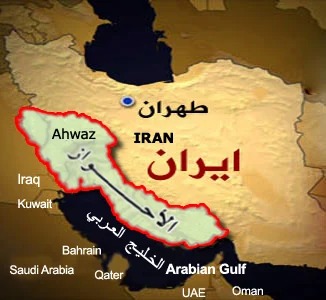
Many people suffer from “geographical illiteracy” regarding Ahwaz, as some believe it is merely a small border strip. However, the numerical reality places us before a geographical catastrophe; the area of the historical Ahwazi lands amounts to 324,000 square kilometers, which is equivalent to 12 times the area of historical Palestine (27,000 square kilometers), and exceeds the combined areas of the Levantine countries (Syria, Jordan, Lebanon, and Palestine).
Ahwaz is considered the backbone of Iran’s economy, as it contains nearly 80% of the oil and gas reserves under Tehran’s control, and possesses the most fertile agricultural lands and freshwater resources supplied by the Karun River.
Nevertheless, these resources are used to revitalize Persian cities in the interior, while the Arab owners of the land suffer from extreme poverty, systematic marginalization, and environmental pollution affecting their lands and waters.
The Night of the Fall and the Treacherous Stab (1925)
Until the beginning of the twentieth century, Ahwaz was an independent Arab state known as the “Kaabi Emirate” in the Mohammerah region, under the rule of Sheikh Khazal Al-Kaabi, who administered the emirate through an independent political system and maintained direct diplomatic relations with international powers.
In April 1925, a vile conspiracy was carried out under the leadership of Shah Reza Pahlavi. Sheikh Khazal was lured onto a military yacht under the pretext of negotiations, only to be captured and transported in chains to Tehran, simultaneously with a comprehensive Persian military invasion of the State of Ahwaz.
Prince Khazal remained imprisoned for more than a decade before being physically eliminated by strangulation in 1936, thus bringing the era of official Arab sovereignty to an end amid disgraceful international silence at the time.
The Guillotine of “Persianization”.. A War on Identity
Following military control, Tehran launched policies of “systematic Persianization” to crush Arab identity through arbitrary measures, including replacing the name “Arabistan” with “Khuzestan” and changing city names; thus Mohammerah became “Khorramshahr,” Abadan became “Abadan,” and Salihiyah became “Andimeshk.”
Education in the Arabic language was also prohibited, Arabic books were banned, and speaking Arabic in official institutions and courts was forbidden.
Families were likewise prevented from giving their children authentic Arabic names, and Persian names were imposed as a condition for obtaining official identification documents.
In addition, the Iranian occupation authorities implemented a demographic change plan through a policy of settling hundreds of thousands of Persians in Ahwaz and constructing luxurious settlements for them at the expense of the lands of displaced Arab citizens.
The Lessons of History and Political Insights
The tragedy of Ahwaz confirms that Persian nationalist expansionist tendencies remain constant regardless of changes in regimes.
The difference between the secular Shah and the religious turbaned regime does not lie in policy toward non-Persian peoples, as both participated in policies of repression and the destruction of identity.
The lesson to be learned here is that the ideological slogans raised by Tehran in international forums evaporate at the boundaries of its expansionist interests.
Early vigilance in protecting Arab frontiers and safeguarding national identity is not an intellectual luxury; rather, it is the only safety valve for the nation, so that another Arab geography is not swallowed by the storm in an unguarded moment of history.