Earthquake in the British parliament: calls for recognition of Ahwaz independence and the opening of the 1925 archives
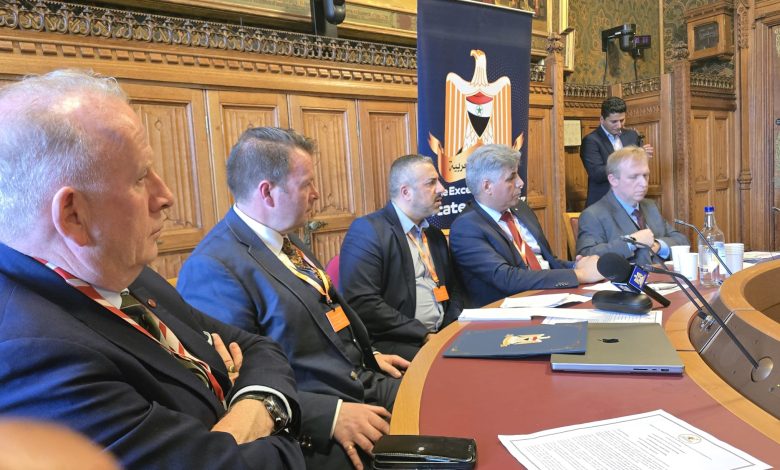
In a notable political move reflecting growing international interest in issues concerning peoples and human rights, the British Parliament hosted a broad and special international conference to discuss developments in the Ahwazi cause, attended by official Ahwazi representation and an international dimension to the conference led by Dr. Aref Al-Kaabi, President of the Executive of the State of Ahwaz.
The corridors of the British capital witnessed the convening of this high-level official conference, which was entirely dedicated to examining the latest developments in the Ahwazi arena and studying the possible legal and international means and mechanisms to support the Arab Ahwazi people in their struggle to obtain their legitimate rights, foremost among them the right to self-determination and independence, amid prominent political, parliamentary, and diplomatic attendance.
A British Parliamentary Platform to Support Ahwazi Rights The conference was marked by high-level and intensive attendance from within the corridors of British decision-making, as a large number of lords and members of parliament from both the British House of Lords and House of Commons participated as keynote speakers, listeners, and contributors to shaping evaluative visions regarding the Ahwazi file.
The list of attendees and advisers (Line-up) included heavyweight and prominent names in British politics, among them Lord Tariq Mahmood Ahmad (Lord Wimbledon) – Lord Ahmad of Wimbledon, Lord David Alton – Lord Alton, Lord Graham Evans – Lord Graham Evans, Member of Parliament Tom Morton – Tom Morton MP, journalist and political analyst David Maddox – David Maddox, and adviser Alistair Thompson – Alistair Thompson.
Attendance was not limited solely to the British and Ahwazi sides, but the conference was distinguished by exceptional international and legal momentum, as the hall witnessed prominent and high-level attendance by an elite group of international lawyers and legal experts specializing in conflict issues, decolonization, and the rights of peoples, along with representatives of major international organizations concerned with human rights and the monitoring of freedoms around the world.
There was also notable and high-level participation by a representative from the International Court of Justice, who closely and attentively followed the documented reports and the legal and political field testimonies presented during the sessions.
In their speeches, the participants addressed the difficult humanitarian and political dimensions experienced by Ahwaz, stressing in firm language the necessity of activating international laws to protect the rights of the Ahwazi people and put an end to the ongoing violations.
A Strategic Step Toward Internationalizing the Cause At the conclusion of the deliberations, those present unanimously agreed on the utmost strategic importance of this parliamentary platform in shedding light on the ongoing suffering in Ahwaz.
Human rights and legal experts stressed that the participation of figures of the stature of a representative from the International Court of Justice and United Nations organizations grants the cause a firmly established legal dimension.
This dimension directly supports the formation of a unified international pressure front to compel the concerned parties to respect human rights conventions, safeguard the fundamental freedoms of peoples, and recognize their historical rights.
The sessions witnessed in-depth and intensive discussions centered on the “official recognition of the State of Ahwaz and its sovereignty” as an indispensable strategic and legal option.
The participants explained in their discussions that recognition not only represents historical justice for an oppressed people, but also constitutes one of the fundamental and effective ways to put an end to the ongoing Iranian violations and confront Tehran’s escalating defiance of the international system, humanitarian values, and regional security.
Parliamentary Consensus and a Demand to Open the British Archives of 1925 In a unified position, all speakers from among members of parliament and members of the British House of Lords affirmed during their presentations and evaluative visions that the fundamental and essential solution to the entire file lies in the full recognition of the State of Ahwaz.
In a remarkable and unprecedented historic step from the heart of London, the participants directed a direct appeal and call to the British government demanding that it open the United Kingdom’s official historical archives to reveal the facts, correspondence, and historical documents connected to Ahwaz.
They also called for accurately shedding light on the events of 1925 and revealing the blatant violations to which the Ahwazi leadership was subjected at that time, along with the complete stripping of sovereignty by the British Empire at the time, which paved the way for the current occupation.
A Call for Broad and Rapid British Media Coverage From the media side, David Maddox, editor-in-chief of the British newspaper “The Independent” and a participant in the conference proceedings, called on British media outlets to immediately move beyond the state of silence and passive neutrality and direct greater and deeper attention toward the Ahwazi cause.
In his speech, Maddox stressed the importance of providing broad, comprehensive, and rapid media coverage aimed at achieving clear strategic goals by lifting the curtain and uncovering the historical concealment surrounding what occurred in 1925 against the State of Ahwaz and its political leadership.
And paving the way on the international stage to examine the available legal and diplomatic means and methods for recognizing Ahwaz as an independent state with full sovereignty, given its highly important geopolitical and strategic location overlooking the northern Arabian Gulf all the way to the Strait of Hormuz, which is vital to global trade and energy movement.
President of the Ahwaz Executive: Rejection of Appeasement and Half-Solutions In the same context, Dr. Aref Al-Kaabi affirmed in a pivotal, detailed, and highly clear speech delivered before the international conference that the long historical silence adopted by Britain regarding what happened in 1925 must end immediately and irreversibly.
Al-Kaabi stressed that the continued concealment and disregard of historical facts is no longer acceptable or possible in light of contemporary international laws and United Nations charters that unequivocally guarantee the rights of peoples to freedom and sovereignty.
In a frank and profound reading of the current and future orientations of Ahwazi policy, Dr. Al-Kaabi clearly defined the features of the Executive Committee’s general position, announcing three strategic noes.
No Appeasement with the Persian Opposition Abroad Al-Kaabi affirmed that the visions and objectives between the two sides never converge, and that the rights of the Ahwazi people are clear, fixed, and non-negotiable, indivisible, and cannot be reduced under any alternative political umbrella seeking to change faces while preserving the essence of the occupation.
No Solutions and No Negotiations with the Current Iranian Regime Al-Kaabi stressed that the current ruling system in Tehran has, over decades, continued to entrench the reality of occupation, repression, and demographic change, thereby completely eliminating any horizon for producing partial or patchwork political solutions with it.
Total Rejection of Half-Solutions Al-Kaabi also affirmed categorically that the Ahwazi leadership and the Ahwazi people do not accept in any way half-solutions or deficient political settlements that fail to meet popular aspirations, and that any regional or international attempt to dilute the cause away from its liberationist essence will be met with absolute rejection and comprehensive political resistance.
The Ahwazi Roadmap: Lifting the Veil and International Recognition The President of the Ahwaz Executive explained before the conference attendees that the actual, sole, and only way out of the historical and current crisis is strictly based on two interconnected steps that must proceed in parallel and for which there is no alternative: completely lifting the veil and removing all forms of ambiguity and secrecy regarding what occurred in 1925, when Ahwazi sovereignty was ended through unjust decisions, and then adopting the Ahwazi cause in international and global forums on the basis of this solid historical, legal, and legitimate foundation that is not nullified by the passage of time.
He also stressed comprehensive and conclusive international and Arab recognition of the State of Ahwaz as an ancient Arab land occupied by military force in 1925, and its official declaration as an independent state possessing full and undiminished sovereignty over its recognized historical borders.
Al-Kaabi concluded his comprehensive presentation before the lords, members of parliament, legal experts, and representatives of international bodies by firmly emphasizing that this international recognition of independence is the first and last solution, the beginning and the end, and the only true guarantee for restoring political and security stability to the northern Arabian Gulf region and safeguarding the principles of human rights and the freedom of peoples.
A Notable Diplomatic Movement Deep Within British Decision-Making The broad international conference, held within the corridors of one of the world’s oldest and most important parliaments, undoubtedly reflects a prominent transformation and an unprecedented qualitative shift in the path of diplomatic and legal internationalization of the Ahwazi cause.
The participating members from both the House of Lords and the House of Commons demonstrated great interest and conducted extensive study of the documented files and reports presented and explained during the sessions.
British lawmakers emphasized the utmost importance of shedding light on this issue in international and United Nations forums and examining and activating all available political, diplomatic, and economic pressure tools to protect human rights and support the legitimate aspirations of the Arab Ahwazi people to obtain their freedom, restore their sovereignty, and build their independent state.