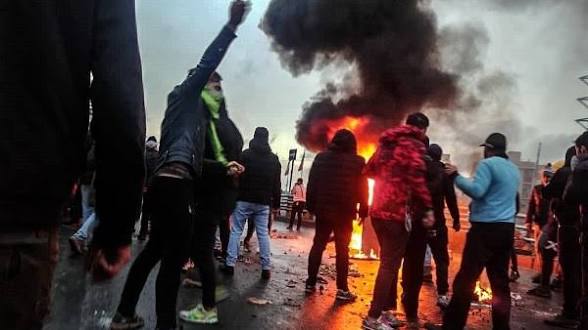
Iran has, in recent years, been facing one of its most complex periods, amid growing popular demands for deep political and economic reforms, while the authorities continue to adopt policies that are distant from the daily priorities of citizens.
As economic crises worsen and living standards decline, the gap is widening between the aspirations of broad segments of Iranians and the orientations of the ruling regime, making the issue of reforms one of the most prominent challenges facing the country in the short and medium term.
The roots of the current popular demands stem from economic and political accumulations that have extended over decades, but their intensity has clearly increased since 2017, when Iran witnessed successive waves of protests that spread across dozens of cities.
In the protests of late 2017 and early 2018, then the November 2019 protests linked to rising fuel prices, and finally the widespread protests that erupted in 2022 following the death of Mahsa Amini while in police custody, demands emerged that went beyond living conditions to include issues of public freedoms, political reform, the role of security institutions, and decision-making mechanisms within the state.
Economically, Iran faces major challenges that have directly affected the lives of citizens.
According to official data issued by the Central Bank of Iran and the Statistical Center of Iran, in addition to estimates by the International Monetary Fund, the country has experienced high inflation rates in recent years, exceeding 50 percent during some periods, while the value of the national currency has declined sharply compared to its levels a decade ago.
This has led to a decrease in the purchasing power of Iranian households and an increase in the costs of housing, food, and essential services.
The Iranian economy continues to face chronic structural difficulties. International sanctions imposed on Tehran because of its nuclear program and regional policies have affected foreign investment and external trade. however, many Iranian economic experts also point to internal factors, including weak transparency, the expanding influence of quasi-governmental institutions, and the persistence of bureaucracy and administrative corruption.
Reports issued by Iranian oversight bodies in recent years indicate corruption cases involving billions of dollars in various sectors, reinforcing the public perception that mismanagement constitutes a fundamental part of the crisis.
These conditions are clearly reflected in the labor market. According to data from the Statistical Center of Iran, young people and women face the greatest employment challenges.
The country is also witnessing a continuous wave of migration among scientific and professional talent. International estimates indicate that Iran is among the countries recording relatively high rates of migration among university graduates, as doctors, engineers, and researchers seek better opportunities abroad.
This phenomenon is viewed as an indicator of declining confidence in the ability of the local economy to provide suitable opportunities for professional growth and economic stability.
Politically, reformist demands revolve around expanding political participation, strengthening civil liberties, and increasing the independence of elected institutions.
Many Iranian activists and reformists believe that the current political system grants broad powers to unelected institutions, limiting the ability of elected governments and parliaments to implement substantial reforms.
These criticisms have increased following the decline of reformist currents within governing institutions in recent years and the decrease in voter participation rates in some electoral processes compared to earlier periods.
On the other hand, the Iranian authorities emphasize that the country faces unprecedented external pressures and that the priority is to preserve political and security stability and confront sanctions and regional threats.
State institutions also maintain that some protests have been subject to attempts at exploitation by external parties seeking to destabilize the country.
This position is based on the complex regional environment in which Iran operates and on the continuation of disputes with the United States and several Western powers regarding the nuclear file and regional policies.
However, a broad segment of Iranians believes that the continued focus on external issues comes at the expense of addressing domestic crises.
This was clearly evident in many of the protests witnessed across the country, where demonstrators raised slogans demanding that priority be given to the local economy, employment opportunities, and public services.
Demands have also intensified among various professional groups, including teachers, workers, and retirees, for improved wages and their alignment with rising inflation rates.
The Iranian government faces an additional challenge represented by the widening gap between the center and certain peripheral regions that suffer from higher rates of unemployment, poverty, and weak services.
These disparities have become apparent in a number of local protests that have taken place in different regions during recent years, where demands were linked to issues of development, infrastructure, and a fairer distribution of resources.
At the economic level, experts believe that addressing the crisis requires structural reforms, including improving the investment climate, strengthening the role of the private sector, reducing monopolies, and combating corruption more effectively.
The prospects for economic recovery are also linked to the possibility of easing external tensions that affect trade, investment, and capital flows.
At the same time, analysts believe that economic reforms alone may not be sufficient if they are not accompanied by political steps that strengthen trust between the state and society.