Drugs in Iran.. an escalating social crisis amid accusations of the regime’s failure to protect youth
Over recent years, the issue of drugs in Iran has transformed from a limited health and social crisis into one of the most complex issues inside the country, amid rising addiction rates and the spread of narcotic substances in streets, poor neighborhoods, and even among younger age groups.
This crisis has placed the Iranian authorities under increasing criticism from activists and social experts who believe that government policies have failed to contain the phenomenon, while opponents go further by accusing influential institutions within the state of tolerating smuggling networks or indirectly benefiting from the drug economy, which has expanded as a result of sanctions and economic crises.
The issue gains particular sensitivity because of Iran’s geographical location, as the country forms a major transit route between Afghanistan, which for decades was the world’s largest producer of opium, and regional and international markets.
This location has placed Iran in direct confrontation with cross-border drug trafficking, but at the same time it has contributed to an unprecedented rise in local consumption rates compared to countries in the region.
Data from the United Nations Office on Drugs and Crime indicate that Iran is among the countries with high rates of opioid consumption, particularly opium, heroin, and synthetic drugs.
The UN office also confirmed in recent reports that the country faces a “serious challenge” linked to the spread of addiction and the increasing use of synthetic stimulants among youth.
Notably, the crisis is no longer associated only with traditional drugs, but has extended to the widespread proliferation of cheap and fast-acting synthetic substances such as “shabu” and methamphetamine, substances that have become increasingly common in major cities.
Specialists link this shift to rising rates of poverty, unemployment, and declining purchasing power, as cheaper synthetic drugs have become more widespread among youth and the unemployed.
Economically, Iran has for years suffered severe pressure as a result of international sanctions, the decline in the value of the local currency, and rising inflation rates, factors that have contributed to creating a fragile social environment that has pushed many young people toward addiction or drug dealing as a quick source of income.
According to circulating official Iranian estimates during recent years, millions of Iranians use drugs to varying degrees, while treatment and rehabilitation centers face increasing pressure exceeding their capacity.
United Nations reports confirm that drug trafficking continues to pose a broad security threat in Iran despite repeated security campaigns, especially on the eastern borders with Afghanistan.
International reports also indicated that the sharp decline in Afghan opium production following the ban decisions imposed by the Taliban movement in 2022 could lead to dangerous shifts in regional drug markets, including the spread of more lethal synthetic opioids.
On the other hand, Iranian opponents believe that the crisis is no longer merely the result of geographical or economic factors, but reflects a structural failure in the state’s management of the social file.
They base this view on the expansion of smuggling networks inside the country and the continued flow of narcotic substances despite the strict security grip imposed on political and media activity.
Accusations are also repeatedly raised on opposition platforms against certain influential entities for turning a blind eye to the drug trade or using it as a tool to weaken society and divert youth away from political and protest activity. However, there is no publicly declared judicial evidence or documented international reports proving the existence of an official systematic policy to spread drugs.
Nevertheless, criticism directed at the authorities is not limited only to the political opposition, but also extends to social experts inside Iran who warn that the security approach alone is insufficient to address the phenomenon.
While the authorities continuously carry out arrest and confiscation campaigns, social studies and UN reports indicate that the roots of the crisis are primarily linked to poverty, marginalization, unemployment, and weak psychological and health services.
The government also faces criticism related to the way it manages the treatment and rehabilitation file.
Despite the existence of treatment programs supported by the United Nations Office on Drugs and Crime, the scale of the crisis exceeds the available capabilities, especially in poor neighborhoods and marginalized areas.
UN reports indicate that women, youth, and marginalized groups are the most affected by substance abuse disorders, with rising social and health costs associated with addiction.
The security and social repercussions of the crisis have become evident in Iranian cities, where rates of homelessness, petty crime, and domestic violence linked to addiction have increased.
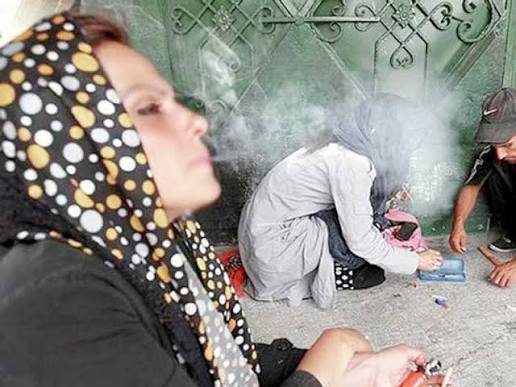
Scenes of drug users in some streets and public places have also become part of daily reality in a number of urban areas, sparking a wave of concern within Iranian society regarding the future of the youth population facing escalating economic and psychological pressures.
Politically, the drug crisis represents an additional challenge for the Iranian authorities at a time when the country is experiencing repeated social tension due to living conditions and rising rates of unemployment and migration.
Activists believe that the continued spread of addiction could lead to further social erosion and loss of confidence in official institutions, especially if the response remains confined to the security dimension without implementing broader economic and social reforms.
In contrast, the Iranian authorities affirm that they are waging a costly battle against drug smuggling, pointing to the killing and injury of thousands of security personnel during past decades in clashes with smuggling networks on the eastern borders.
Tehran also highlights its ongoing cooperation with the United Nations in treatment, harm reduction, and anti-drug trafficking programs, in an attempt to demonstrate that the country is not lenient toward the phenomenon but rather bears a major regional burden because of its geographical location.
The drug crisis in Iran appears more complex than merely a security or health issue, as it is linked to an intertwined set of economic, social, political, and regional factors.