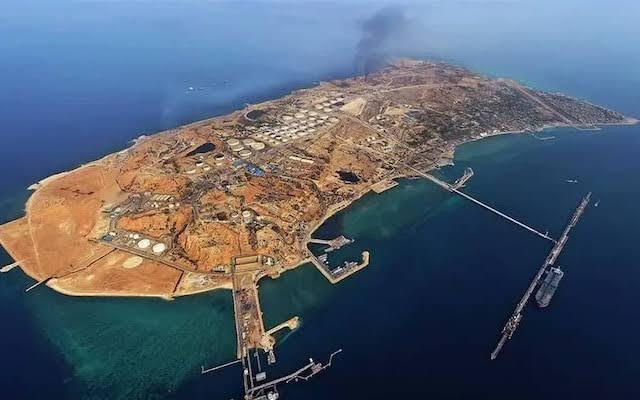
Kharg Island… The stolen pearl of Al-Ahwaz in the arabian Gulf
The issue of Arab Al-Ahwaz remains one of the forgotten causes in the conscience of the Arab nation, despite representing one of the most complex cases of occupation and cultural and identity erasure in contemporary history.
In 1925, Shah Reza Pahlavi overthrew the Arab state of Al-Ahwaz, led by Prince Sheikh Khazal Al-Kaabi, annexing it by force to the Iranian state in a conspiracy involving Britain.
This marked the beginning of a new phase of systematic marginalization and exploitation of this resource-rich and historically significant Arab land.
Occupied Al-Ahwaz extends over a vast area overlooking the Arabian Gulf, inhabited by an Arab majority estimated in the tens of millions.
These populations remain deeply connected to their language, heritage, and authentic Arab identity, despite decades of coercive Iranian policies aimed at erasing and dissolving this identity.
Among the most prominent landmarks of this occupied region is the Arab island of Kharg, from which not only its wealth but even its name has been taken, standing as a stark symbol of the contradiction between immense riches and the impoverishment of its people.
Its original Arab name is “Kharg,” a name passed down through generations among its inhabitants, before Iranian authorities renamed it “Khark” in line with a systematic policy of erasing Arab names and Persianizing them.
This policy has not been limited to Kharg Island alone, but has extended to hundreds of cities, villages, rivers, and mountains across Al-Ahwaz that once bore authentic Arab names.
Geographical location and naming
Kharg Island lies at the heart of the Arabian Gulf, approximately twenty-five kilometers off the southwestern coast of Iran, midway between the Iranian shores and the Arabian Peninsula.
Its area is only about twenty square kilometers, yet the economic and strategic significance it holds makes it one of the smallest islands with a substantial impact on the global economy.
Kharg Island is located about 25 kilometers off the Ahwazi coast, northwest of the Strait of Hormuz, in waters deep enough to accommodate oil tankers whose massive size prevents them from approaching the shallow waters of the mainland coast.
It lies approximately 55 kilometers northeast of the Ahwazi port of Bushehr and about 15 nautical miles from the Ahwazi mainland.
The island belongs to the coral islands of the Arabian Gulf, giving it a distinctive geological character.
Strategic oil importance
Kharg Island derives its exceptional importance from being Tehran’s primary oil terminal—indeed, the artery through which the economic lifeblood of the Iranian state flows.
Through its massive oil facilities, more than ninety percent of Ahwazi oil exports under Tehran’s control pass to global markets, making it the backbone of the occupying Iranian state’s economy and an indispensable asset.
The island hosts an integrated system of oil infrastructure, including massive storage tanks capable of holding millions of barrels, advanced marine terminals able to receive supertankers, as well as pipeline networks linking it to major oil fields on the Ahwazi mainland.
Khark Island, which processes 90% of Iran’s oil exports, has according to Axios, citing officials in the U.S. administration become the subject of serious discussion rather than mere contingency planning.
This signals that the war may be approaching a decisive moment that could transform it from a limited regional conflict into a comprehensive global economic catastrophe.
This pivotal position made it a highly strategic target during the Iran–Iraq War in the 1980s, when it was subjected to repeated bombardment aimed at disrupting the Ahwazi oil artery under Iranian control.
Economic experts estimate that halting oil operations on Kharg Island for just one week would be sufficient to paralyze Tehran’s economy and inflict severe losses that cannot be compensated in the short term, underscoring the unique status this small island occupies within Iran’s economic system.
Population and demographic composition
The population of Kharg Island is approximately ten thousand people, the vast majority of whom belong to Arab tribes and families that have inhabited the island for generations.
These residents live amid a painful contradiction: beneath their feet flow rivers of oil and before their eyes billion-dollar deals are conducted, yet they endure poverty, marginalization, and exclusion from administrative positions and high-value jobs in the very facilities built on their land.
Moreover, they find themselves further marginalized under policies of displacement and settlement pursued by the Iranian authorities, aimed at altering the demographic character of the region.