An economy under pressure: how administrative imbalances have contributed to the escalation of poverty and unemployment in Iran
In recent years, Iran has faced mounting economic challenges that have been clearly reflected in rising levels of poverty and unemployment, amid a complex mix of international sanctions and internal structural imbalances.
While some of these crises are attributed to external pressures, the role of economic management emerges as a decisive factor in explaining both the depth and persistence of the crisis.
Weak efficiency in public policies, coupled with erratic economic decision-making, has undermined the Iranian economy’s ability to absorb shocks, contributing to the erosion of living standards and the widening scope of poverty.
The roots of this crisis trace back to years of excessive reliance on oil revenues, which left the economy vulnerable to price fluctuations and sanctions.
Following the withdrawal of the United States from the nuclear agreement in 2018 and the reimposition of sanctions, Iran’s gross domestic product contracted by approximately 6% in 2018 and 7% in 2019, according to estimates by the International Monetary Fund.
This sharp contraction was not met with effective reform policies aimed at restructuring the economy or strengthening domestic production.
Instead, it coincided with the continued extensive state intervention in markets, which limited the efficiency of economic allocation.
Official data show that the unemployment rate in Iran has ranged between 9% and 11% in recent years; however, these figures conceal significant disparities, particularly among youth and women.
World Bank estimates indicate that youth unemployment exceeded 20% during certain periods, a figure that reflects deep structural imbalances in the labor market.
This is partly attributed to weak alignment between educational outputs and market needs, in addition to restrictions imposed on the private sector, which suffers from a complex regulatory environment and a lack of investment incentives.
At the same time, poverty rates have witnessed a marked increase, Local economic reports have shown that the proportion of the population living below the poverty line has risen significantly over the past decade, alongside the erosion of purchasing power due to high inflation.
According to official data, the inflation rate has exceeded 50%, a high level that directly affects low- and middle-income households.
This inflation is attributed to several factors, including the weakness of the local currency, increased unproductive government spending, and imbalances in the subsidy system.
The management of monetary and fiscal policies represents one of the most prominent manifestations of dysfunction.
Deficit financing and reliance on money printing to cover expenditures have increased inflationary pressures.
Moreover, the multiplicity of exchange rates, which the government has adopted for extended periods, has created a fertile environment for speculation and corruption, as certain actors have benefited from the gap between official and market rates to generate non-productive profits.
This system has not only distorted the market but has also led to the waste of public resources.
In addition, bureaucracy and weak governance have played a role in undermining economic activity.
International reports indicate that Iran ranks relatively low in ease of doing business indices, reflecting the complexity of administrative procedures and the lack of transparency.
This reality limits the ability of small and medium-sized enterprises to grow, despite being among the most important sources of job creation.
Furthermore, the dominance of quasi-governmental institutions over broad sectors of the economy reduces opportunities for competition and constrains innovation.
Conversely, the Iranian government views economic sanctions as the primary factor behind the deterioration of conditions, as they have led to declining oil exports and restricted access to international financial markets.
Undoubtedly, these sanctions have had a significant impact. Oil exports declined from approximately 2.5 million barrels per day prior to 2018 to less than one million barrels per day in some subsequent periods.
However, economic experts point out that the impact of sanctions has been exacerbated by the absence of effective internal policies for adaptation, such as economic diversification and the strengthening of domestic production.
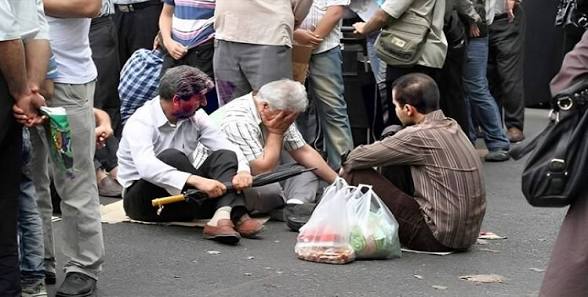
These challenges are directly reflected in society, as they have led to declining living standards and widening social disparities.
Real wages have declined significantly, amid rising prices of essential goods such as food and housing.
Rates of informal employment have also increased, meaning the absence of social protection for a wide segment of workers.
Estimates indicate that a large proportion of the labor force is engaged in unstable jobs, increasing the economic vulnerability of households.
On another level, these conditions have contributed to escalating social tensions, with the country witnessing repeated protests linked to economic conditions, most notably in 2019 and 2022.
These protests reflect a state of dissatisfaction with economic performance and highlight the relationship between economic management and social stability.
As living pressures intensify, the likelihood of unrest increases, posing an additional challenge for policymakers.
In light of these factors, future prospects appear contingent on several elements, most notably the government’s ability to implement genuine structural reforms.
These reforms include improving the business environment, restructuring the subsidy system, enhancing transparency, and reducing reliance on oil.
Any improvement in international relations could also alleviate some of the pressures, but it will not be sufficient without deep internal reform.
Conversely, economists warn that the continuation of current policies may lead to further deterioration, particularly in light of population growth and rising demand for jobs.
They point out that addressing unemployment and poverty requires a comprehensive strategy focused on creating sustainable employment opportunities, improving productivity, and strengthening the role of the private sector.
The rise in poverty and unemployment rates in Iran ultimately reflects the result of a complex interaction between external pressures and poor domestic economic management.