Discovery of an Environmental Treasure in Ahwaz
In a unique two-phase exploratory journey lasting two weeks, Mohammad Shah, head of the Bird Monitoring and Protection Team at the Kuwait Environment Protection Society, managed to record 230 bird species in the occupied Arab region of Ahwaz.
The journey began at Shuwaikh Port in Kuwait and reached the port of Mohammara in Ahwaz.
The expedition led by the head of the Bird Monitoring and Protection Team resulted in the discovery of 30 new bird species previously unrecorded in the region.
Mohammad Shah became the first Arab to carry out bird monitoring of this kind in Ahwaz, noting that this trip was part of a joint effort between the Kuwait Environment Protection Society and the Biodiversity Group in the occupied Arab region of Ahwaz, aimed at documenting the area’s biodiversity.
The first phase of the journey began on April 17, when Shah and his team boarded a ferry from Kuwait’s Shuwaikh Port to Mohammara in Ahwaz.
From there, the team headed north toward Quneitra, passing through farms and orchards rich in diverse bird species, before continuing to the Dez River Dam Lake northeast of Quneitra.
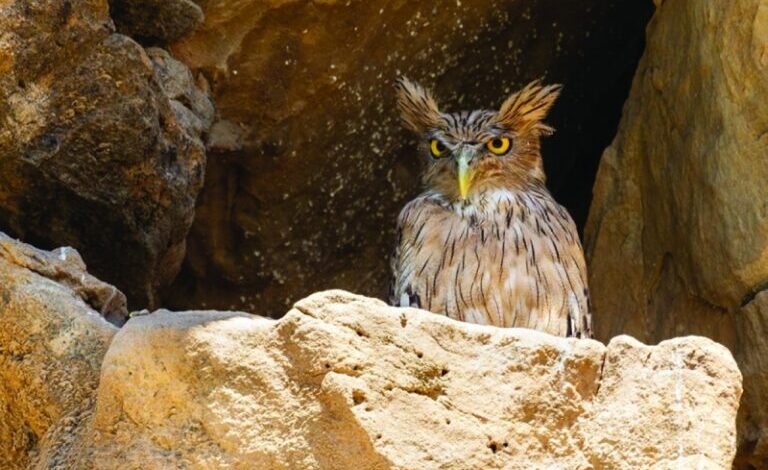
In the village of Islam Abad, the team was guided by a local in search of the Brown Fish Owl, and Shah met with a group of foreign birdwatchers from Russia and Kazakhstan.
The tour included different areas of Quneitra, such as mountains and agricultural plains. Among the highlights was Mount Salan, rising 2,000 meters above sea level, where several bird species were observed, including the Syrian Woodpecker nesting in a tree trunk.
Vultures were spotted soaring at high altitudes, along with migratory birds such as the Common Cuckoo, Song Thrush, and the Black-eared Wheatear, which is a breeding species in the region.
The team also explored valleys, agricultural fields, and Quneitra farms, where White Stork nests and Stock Doves were found along the banks of the Dez River.
In later stages, the team moved to the interfluvial forest between the Dez and Karun rivers, where they recorded a pair of Pied Wheatears with their chicks, along with other species such as the Indian House Swift, Iraqi and Afghan Babblers, and the European Turtle Dove.
The tour concluded with the recording of 193 bird species in Ahwaz, according to Kuwait’s Al-Rai newspaper.
In the second phase, the team continued its exploration in the vast Hoor al-Huwaiza wetland, where around 113 bird species were recorded. Most were waterbirds such as the Marbled Teal, Ferruginous Duck, and Mallard, in addition to various types of herons and other species that enriched the final list of recorded birds.
Ahwaz is a crucial hub for bird migration across three continents Asia, Europe, and Africa.
The region hosts diverse habitats, including Mesopotamian wetlands, rivers, old riverine forests, the Zagros mountain range, deserts, plains, seashores, and islands.
These provide a suitable environment for around 405 bird species, representing approximately 71% of the region’s birdlife.
Beyond bird diversity, Ahwaz is home to 77 mammal species, 85 reptile species, and five amphibian species, making it a highly significant area for biodiversity conservation.