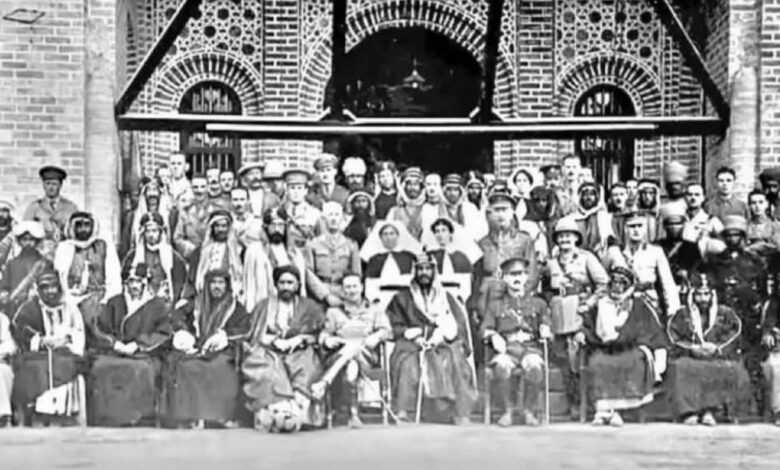
A Rare Photo of King Abdulaziz Al Saud and Ahwazi Ruler Sheikh Khazal Al-Kaabi Sparks Social Media and Revives Historical Influence
A rare historical photo from the early 20th century has gone viral on social media, showing the founder of the Kingdom of Saudi Arabia, King Abdulaziz Al Saud, seated at the center. To his left is the British Resident in the Arabian Gulf, and to his right is the then ruler of Al-Ahwaz, the martyred Sheikh Khazal Al-Kaabi, inside his palace in the city of Basra.
The photo has generated widespread attention due to its powerful political and historical symbolism.
It reflects the prominent status of Sheikh Khazal Al-Kaabi, not only within Al-Ahwaz but also regionally and internationally. Sheikh Khazal was considered one of the most influential Arab leaders in the Gulf region at the time, maintaining strong ties with global powers—most notably Britain.
Analysts point out that King Abdulaziz, who was still in the early stages of building his new state at the time, sitting alongside Sheikh Khazal and the British Resident, reveals the true balance of power back then. Sheikh Khazal was regarded as a powerful Arab figure with actual sovereignty over the resource-rich land of Al-Ahwaz, especially known for its oil wealth.
The photo also highlights that Sheikh Khazal’s palace in Basra was more than just an administrative center it served as a meeting place for leaders and prominent regional figures.
This reinforces his image as a strong and independent ruler who held extensive authority before Al-Ahwaz fell under Iranian occupation in 1925.
Sheikh Khazal Al-Kaabi remains a prominent historical figure in the collective memory of the Ahwazi people, remembered as the last independent Arab ruler of Al-Ahwaz.
He was later assassinated under mysterious circumstances after being exiled to Tehran, in what is considered one of the most heinous political crimes committed by the Iranian state against Arab leaders.
This photo brings renewed attention to Al-Ahwaz’s erased history, serving as a reminder to younger generations that Al-Ahwaz once enjoyed full sovereignty under an Arab leader who was respected by his peers across the Arabian Peninsula and the Gulf long before it became a scene of occupation, repression, and systematic violations.
Political figures and historians are calling for a renewed reading of this crucial chapter in modern Arab history and the revival of its key symbols most notably the martyr Sheikh Khazal Al-Kaabi, who stands as a symbol of the dignity and lost sovereignty in Al-Ahwaz today.